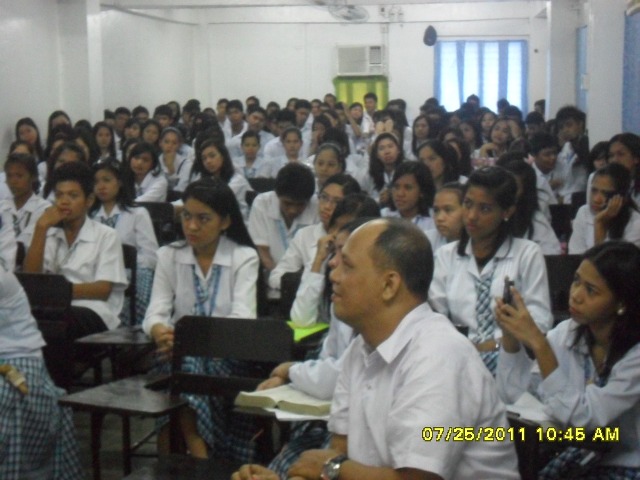
2nd Monthly Students' Fellowship


For the final papers in Rizal's Life and Works (Main Campus), submission is extended until tomorrow 7pm due to suspension of classes today. 


Enjoy the rest of the day!
Classes are suspended today at all levels in the entire National Capital Region. This is due to Typhoon Juaning. 

Meanwhile, please read the following weather forecast from PAGASA.


Severe Weather Bulletin Number EIGHT Tropical Cyclone Warning: Tropical Storm "JUANING" {NOCK-TEN} Issued at 5:00 a.m., Wednesday, 27 July 2011
Tropical Storm "JUANING" continues to threaten Central Luzon including Metro Manila.
Location of Center:
(as of 4:00 a.m.)
90 km East of Infanta, Quezon 
Coordinates:14.8°N, 122.5°E
Strength:Maximum winds of 85 kph near the center and gustiness of up to 100 kph
Movement:West Northwest at 11 kph. 
Forecast Positions/Outlook:Wednesday morning:Expected to make landfall over Polillo Island between 8am to 10am and over Southern Aurora by 1pm to 3pm today
and will traverse Central Luzon
Thursday morning:in the vicinity of Dagupan City
Friday morning:410 km West Northwest of Laoag City 
Areas Having Public Storm Warning Signal
PSWS #LuzonVisayasMindanao
Signal No. 2
(60-100 kph winds)
Camarines Norte
Quezon
Polillo Island
Batangas
Laguna
Cavite
Rizal
Bulacan
Pampanga
Bataan
Zambales
Tarlac
Pangasinan
Nueva Ecija
Aurora
Quirino
Nueva Vizcaya
Benguet
La Union
Metro Manila
NoneNone
Signal No. 1
(45-60 kph winds)
Catanduanes
Camarines Sur
Albay
Burias Is
Romblon
Mindoro Provinces
Lubang Is.
Isabela
Ifugao
Mt. Province
Kalinga
Ilocos Norte
Ilocos Sur
Abra
Apayao
Cagayan
NoneNone
Public Storm Warning Signals elsewhere are now lowered.

Residents in low lying and mountainous areas under signals #2 & # 1 are alerted against possible flashfloods and landslides. Likewise, those living in coastal areas are alerted against big waves or storm surges generated by this tropical cyclone.

TS "JUANING" will continue to enhance the Southwest Monsoon and will bring widespread rains over the Rest of Luzon and Western Visayas.

The public and disaster coordinating councils concerned are advised to take appropriate actions and watch for the next bulletin to be issued at 11 AM today and the hourly updates. 

Announcement for Rizal's Life and Works students (Main Campus)


ATTENTION:

Rizal’s Life and Works students
Friday, 10:00am-1:00pm, Room 308

Please get your draft papers of your movie and article reviews from the Faculty Room.

Submission of final papers is on July 27, 2011 (Wednesday) until 7:00pm. For those who already received their draft papers last Friday, submission will be on Tuesday until 7:00pm.

Submit your papers to Sir Reagan or Sir Brian.

Thank you.

RAQUEL, M. B. 

College Life Video


Buloy Video


BCDA donates land for UP in Taguig


Soon, there will be a UP campus in the City of Taguig! University of the Philippines The Fort? Watch out for it!

=============================================================

Plans for a UP presence in Taguig are underway with the donation of a 4,300-square meter lot in Bonifacio Global City (BGC) by the Bases Conversion Development Authority (BCDA).

UP President Alfredo E. Pascual signed a memorandum of agreement (MOA) with deed of conveyance with the BCDA through its president and chief executive officer, Arnel Paciano Casanova, on July 19 at the UP Board Room in Quezon Hall.

BCDA is a government agency created by virtue of Republic Act 7227, also known as the Bases Conversion and Development Act of 1992, signed into law by former President Corazon C. Aquino on March 13, 1992. It was responsible for leading and providing directions in the conversion of former US military bases as well as military camps in Metro Manila into growth centers. It also played a vital role in the modernization of the Armed Forces of the Philippines by contributing funds to the program.

According to the MOA, BCDA donated to UP a 4,300 –square meter lot at the BGC for the UP professional schools which will initially include the College of Law (CL), College of Business Administration (CBA), College of Engineering (CoE), School of Statistics (SS) and the UP Open University (UPOU). The facility is also expected to accommodate continuing education programs of other UP units.

In his message during the ceremony, Pascual said “UP at The Fort will not only strengthen UP’s role as a key player in development. It will also further widen its reach in serving our people, particularly students and professionals from southern Metro Manila.”

In addition, he said “In the future, we can expect more continuing education programs of other UP units making their mark on this side of the metropolis. This is a continuing challenge for UP and for those who regard education as a tool for empowerment in the service of the nation.”

Having a UP campus in BGC was initially proposed by National Academy of Science and Technology (NAST) president, Dr. Emil Javier, during his term as UP president.

The proposal now turned into reality after Senator Franklin Drilon facilitated the donation by BCDA of the project site which was originally planned to be leased to UP.

Among those present during the MOA signing were former Department of Agrarian Reform secretary Rene Villa; former UP president Dr. Emerlinda R. Roman; Dr. Elvira A. Zamora, UP’s VP for Development; Drilon, BCDA Chairman Felicito C. Payumo, two BCDA members, Atty. Teresita A. Desierto, commissioner on Housing and Land Use Regulatory Board;  Aileen An.R. Zosa, BCDA executive vice president; Prof. Danilo A. Arao, Assistant VP for Public Affairs; Prof. Christopher S. Espina, Office of Design and Planning Initiatives director; Dr. Maragtas Sofronio V. Amante, VP for Administration; Dr. Grace J. Alfonso, UP Open University chancellor; Dr. Aura C. Matias, CoE dean; Atty. Danilo L. Concepcion, VP for Legal Affairs and CL dean; Dr. Ben Paul B. Gutierrez, CBA dean; and Prof. Armin B. Sarthou, former VP for Development.

Dr. Jose Wendell P. Capili, AVP for Public Affairs and Office of Alumni Relations director, hosted the MOA signing ceremony. —H.C.P. with reports from the UP System Information Office


Prelim Exam Schedule

Prelim Examination Schedule:


July 16 (Saturday)-22 (Friday), 2011


Secure Examination Permits from the College Office.

Announcement for Rizal's Life and Works students in the Main Campus

For students of Rizal's Life and Works in the Main Campus:


Deadline of submission for the DRAFT PAPER for Movie Review and Article Review is on Friday next week, July 22 until 1:00PM. 


Take note that these reviews are equivalent to your prelim exam. As agreed upon by the class, no prelim exam will be given. 


If you fail to submit the draft papers on Friday, that means your grade for the prelim exam is 60%. You cannot submit FINAL PAPERS without submitting the draft papers first. 

For students of Rizal's Life and Works class

For Rizal's Life and Works prelim requirements:


Failure to submit the draft reviews (movie review and article review) means that any paper will not be accepted on the deadline of submission for the final paper.


In other words, you NEED to submit your draft reviews first as I will edit your essays.

Submission of Graphic Organizer

*************************************************************


Submission of GRAPHIC ORGANIZER in General Psychology for Sessions 1-4 topics will be TOMORROW until 12:00 noon only. 


No extension of deadline is allowed!
Deadline of submission: TONIGHT at 11:59 PM

*** No extension of deadline is allowed. 

*** Assignments submitted through emails will not be considered.


Enjoy your night. 

Happy weekend!


Thank you for the birthday greetings!


Advanced Birthday Celebration at C5 Annex Campus


HAPPY BIRTHDAY TO ME!


Birthday Gift from A FRIEND -- THE NORTH FACE BACKPACK


To all my students, thank you for the greetings. I appreciate you all.


Thanks to Sir Bryan, Sir Reagan, Sir Abet, Sir Rovie Roy, Sir Almar, Ma'am Marianne, Ma'am Grace, and Ms. Escopel.

I'll be watching Transformers 3: Dark of the Moon 3D tomorrow night! I'll treat myself!
I just want to remind everyone that our deadline of submission for all your assignments online in ALL subjects will be on JULY 9, 2011 (SATURDAY), until 11:59PM.


No extension of deadline will be allowed. There is NO EXEMPTION!


Thank you.


Marlon B. Raquel
Instructor


You will be submitting TWO REVIEWS as your requirement for Prelim period: one is a MOVIE REVIEW and an ARTICLE REVIEW.


You will be submitting TWO REVIEWS as your requirement for Prelim period: one is a MOVIE REVIEW and an ARTICLE REVIEW.

MOVIE REVIEW

Title of the Film: Jose Rizal
Director: Marilou Diaz-Abaya

Synopsis based on Wikipedia:
“Accused of treason, Dr. José Rizal (Cesar Montano) awaits trial and meets with his government-appointed counsel, Luis Taviel de Andrade (Jaime Fabregas).


The two build the case and arguments for the defense as significant events in the central figure's life prior to his incarceration unfold. Upon hearing his life story, Taviel begins to realize that the accused is not only innocent but exhibits in fact all the qualities of an ordinary man. When the mock trial unreels, Taviel is all set to act as the prime advocate for his client as Rizal himself is about to give an earth-moving speech to defend his honor and address his countrymen.


Meanwhile, the Spanish authorities have worked out the vast political machinery to ensure a guilty verdict. A revolution awaits in the wings. Blood is shed when the Katipunan, founded by Andres Bonifacio (Gardo Versoza), attacks the Spaniards.”

Contents of the Movie Review:

A movie review is NOT all about your reactions – your reactions are just a part of the movie review. While different colleges and individuals use different style and contents in writing a movie review, I suggest that you follow the basic steps. There are four basic parts that you need to provide.
Note: Your movie review should contain at least 1,000 words; short bond paper; 1 inch on all margins; double space; 11 font size Arial.

Title Page

PART I INTRODUCTION
Name of the film – You may include the reason why the movie has been named that way based on what you observe during the film showing. You could also look for references in the web.
Stars of the film specially the prominent ones – Specify the names of the stars in real life and their names used on the actual film. Include also the relationships that exist among them and the role they play in the movie.
The setting – Indicate and describe the place and time of the movie being reviewed.
Type of film – Is the film a comedy, drama, horror, sci-fi, etc? You may search the internet about the different movie genre.

PART II PLOT SUMMARY
Your movie review should include the plot summary. A plot is “all the events in a story particularly rendered toward the achievement of some particular artistic or emotional effect or general theme.” (Wikipedia)

PART III ASPECTS OF THE FILMMAKING
Discuss various aspects of the filmmaking. This includes acting, direction (film director), editing, costume design, set design, photography, background music, etc.

PART IV REFLECTION/SYSNTHESIS
For academic purposes, you need to integrate the concepts, theories, and frameworks on the respective course where the film has been shown. You may include an application of these concepts to your day-to-day life by citing an example.

ARTICLE REVIEW

Read the essay written by Nick Joaquin titled “Anatomy of the Anti-Hero.” Critically analyzed the essay and make your review. Click the title to view the article or you can copy it and print it out.

Note: Your article review should contain at least 1,000 words; short bond paper; 1 inch on all margins; double space; 11 font size Arial.

NEW DEADLINE OF SUBMISSION:
For Tuesday class: July 19, 2011 until 6:00PM
For Thursday class: July 21, 2011 until 6:00PM
For Friday class: July 22, 2011 until 6:00PM


Resources on how to make a good article reviews:
1. Writing an Article Review by Concordia University
2. How to Write a Journal Article Review APA Style


Today is Filipino-American Friendship Day!

 
The Philippines is commemorating the Filipino-American Friendship Day today. It was former President Diosdado Macapagal who moved the original Araw ng Kalayaan ng Pilipinas from July 4 to June 12 in 1962. Before 1962, we were celebrating Philippine Independence Day on July 4. July 4 then became Filipino-American Friendship Day which coincides the Independence Day of the United States of America which is known as The 4th of July. 

My wish is that Filipinos and Americans will continue our strong friendship as democratic nations. Congratulations to the American people for celebrating their Independence Day today and to all Filipinos around the world!

2 Article Reviews for Economics - Prelim Requirement


Click the titles of each article to view the entire text. You may download them and/or print them out.


Article No. 1


Abstract:

Following an earlier paper titled “Population and Poverty: The Real Score”, the present paper was first issued in August 2008 as a contribution to the public debate on the population issue that never seemed to die in this country. The debate heated up about that time in reaction to a revival of moves to push for legislation on reproductive health and family planning (RH/FP). Those attempts at legislation, however, failed in the 13th Congress, and again in the 14th Congress. Since late last year, the debate has been heating up further on the heels of President Noy Aquino’s pronouncements seeming to favor RH/FP, though he prefers the nomenclature “responsible parenthood”. With some updating of the data, this paper remains as relevant as ever to the ongoing public debate. It is being re-issued as a Discussion Paper for wider circulation.

Article No. 2


Constitution: Why National Progress Is at Stake


Abstract:

This paper discusses the beneficial aspects of lifting or liberalizing these restrictions on foreign capital in the Philippine context. Specifically, the restrictions relate to the prohibition of foreign individuals to engage in land ownership, in the exploitation of natural resources, and the ownership of public utilities. Corporations are allowed to participate in these activities only if they have equity ownership only to the maximum extent of 40 percent. In other words, foreign capital can only be a strict minority participation in corporate enterprises to be allowed in these economic activities. 

These provisions have hurt Philippine development over the years. Despite the liberalization of many aspects of the economy, including those in the area of trade, industry, and other aspects of the economy, these economic restrictions continue to hold because they are part of the Constitutional document. Some of these provisions of the Constitution could be relaxed through more liberal citizenship rules. But the basis of citizenship – jus sanguinis or blood relations– is also very restrictive. The need to improve the performance of the Philippine economy requires that these restrictions be examined and reformed. A direction of such reforms would be to place them out of the Constitutional framework – as is the case with most modernizing countries – and put them within the realm of ordinary legislation. In this way, they can be debated more openly and the policies could be suited up to changing conditions and the need for change of the economy.

The Philippine Constitution contains many strong restrictions targeted against the flow of foreign capital in specific areas of economic activities. These restrictions were the same ones that were incorporated into the nationalistic provisions of the
1935 Constitution when its framers were anticipating future political independence.


Note:
  1. Critically analyze each article in an essay form with no less than 1,000 words each.
  2. Your analyses should be HANDWRITTEN in yellow papers.
  3. You can use black or blue ink.
NEW DEADLINE OF SUBMISSION:
July 23, 2011 (Saturday) until 6:00PM 

You may want to read the helpful article published by Concordia University on how to make an article review. Just click the link.

Two articles for Philippine History - Prelim Requirement


INSTRUCTIONS:
Click the link to read each article. You may download them and print the articles or read them online.


SOCIAL SCIENCE DILIMAN (December 2010) 6:2, 79-99

What is Social Science Diliman?
As stated in their website, Social Science Diliman is “an internationally refereed semi-annual journal for the social sciences. It is bilingual (English and Filipino) and both disciplinal and multidisciplinary.” It is published by the Research Dissemination and Utilization Office of the Vice Chancellor for Research and Development of the University of the Philippines, Diliman, Quezon City.


The legal origins of the embryonic Philippine Republic can be traced back over 500 years to a series of papal issuances known as the “Declaration of Alexander,” which provided the Spanish Crown with legal authority to acquire territory overseas. By the time Miguel Lopez de Legazpi arrived in 1565, Spain had already garnered much experience in the management and exploitation of its colonial possessions. King Philip II wanted to prevent a repeat of the brutal conquests in the Americas that belied Spanish attempts to legitimate its colonial enterprise in the name of Christianity. The Manila Synod of 1582 formulated a novel theory upon which Spain staked its legal claim to sovereignty over the Philippine Islands. Through baptism, natives were deemed to have become subjects of the Pope’s spiritual sovereignty while remaining subjects of their own local leaders. The Pope delegated his sovereign powers to the Crown, and the Crown and its subordinates felt legally empowered to promulgate laws deemed necessary, an arrangement some native leaders purportedly agreed to. But many indios resisted. As such Spain never technically acquired full sovereignty over the entire archipelago.


SOCIAL SCIENCE DILIMAN (January 2008-December 2009) 5:1-2, 26-82

What is Social Science Diliman?
As stated in their website, Social Science Diliman is “an internationally refereed semi-annual journal for the social sciences. It is bilingual (English and Filipino) and both disciplinal and multidisciplinary.” It is published by the Research Dissemination and Utilization Office of the Vice Chancellor for Research and Development of the University of the Philippines, Diliman, Quezon City.


The Calatagan Pot, with an inscription around its rim, is one of the very few existing archeological evidences of ancient writing in the Philippines. It was discovered in Calatagan, Batangas under uncontrolled conditions and bought by the Philippine National Museum in 1961. Having eluded scientific efforts at decipherment since that time, the current paper proposes a strategy which combines traditional palaeographic techniques and cryptographic methods. By means of this procedure, a tentative decipherment of the inscription has been constructed. The experimental results show that the ancient inscription may be a spell or charm in a central Philippine language with a Javanese admixture.


NEW DEADLINE OF SUBMISSION:

July 21, 2011 (Thursday), until 6:00 PM only for Thursday class 

July 22, 2011 (Friday), until 7:00 PM only for Friday class


Take note: Article reviews must be HANDWRITTEN on yellow papers (3 pages each article).


Resources on how to make a good article reviews:


INSTRUCTIONS:
Click the link to read each article. You may download them and print the articles or read them online.


ARTICLE NO. 1


SOCIAL SCIENCE DILIMAN (January 2008-December 2009) 5:1-2, 107-127

What is Social Science Diliman?
As stated in their website, Social Science Diliman is “an internationally refereed semi-annual journal for the social sciences. It is bilingual (English and Filipino) and both disciplinal and multidisciplinary.” It is published by the Research Dissemination and Utilization Office of the Vice Chancellor for Research and Development of the University of the Philippines, Diliman, Quezon City.


The fundamental position of the Philippines regarding the extent of its territorial and maritime boundaries is based on two contentious premises: first, that the limits of its national territory are the boundaries laid down in the 1898 Treaty of Paris which ceded the Philippines from Spain to the United States; and second, that all the waters embraced within these imaginary lines are its territorial waters. The position of the Philippine Government is contested in the international community and runs against rules in the Law of the Sea Convention, which the Philippines signed and ratified. This situation poses two fundamental unresolved issues of conflict: first, is the issue on the breadth of its territorial sea, and second, its treatment of supposed archipelagic waters as internal waters. The twin issues of the legal status of the Philippine Treaty Limits and its extensive historic claims to territorial waters have been subject of much academic debate and serious criticisms. The delimitation of Philippine territorial and maritime boundaries in conformity with international law necessitates the reform of the existing national legal, policy and administrative framework to resolve fundamental issues of conflict between domestic legislation and international law. This paper, proceeding from both a national and an international legal perspective, aims to clarify the legal status of the Philippine Treaty Limits and territorial waters claim in international law.

ARTICLE NO. 2

Title of the Article: ELECTORAL POLITICS AND CONFRONTING THE CHALLENGE OF BASQUE AND MORO NATIONALISM


SOCIAL SCIENCE DILIMAN (January 2008-December 2009) 5:1-2, 107-127

What is Social Science Diliman?
As stated in their website, Social Science Diliman is “an internationally refereed semi-annual journal for the social sciences. It is bilingual (English and Filipino) and both disciplinal and multidisciplinary.” It is published by the Research Dissemination and Utilization Office of the Vice Chancellor for Research and Development of the University of the Philippines, Diliman, Quezon City.


This article explores the similarities and differences concerning the extent to which electoral politics addresses the concerns of Basque and Moro nationalism.  These demands mainly focus on the factors that have brought about their political, cultural and, for the Moros, also economic marginalization.  In terms of similarities, electoral politics in the form of plebiscites and referendums are used to gauge the sentiments of the Basques and the Moros with regards to approving a national constitution with provisions affecting them as well as the establishment of an autonomous region for the Moros and the strengthening of a federal form of government in the case of the Basques.  Elections are also used to choose their leaders at the local, provincial, regional and national levels.  As for the differences, among the major ones are the following:   One is that electoral politics in the Basque region mirrors the class divide in society and reflects the interests of the constituencies.  This is not the case in Muslim Mindanao whereby patronage politics rules and electoral results are generally dictated by the Muslim elites who have close ties with the national elites. And secondly, the ideological bias of the elected leader and his political power in Spain has a direct impact on Basque nationalism. In the case of the Philippines, it is the personality of the elected leader that determines whether peace negotiations will be pursued or not.  But this does not impact on national or local electoral politics as in the case of Spain.


NEW DEADLINE OF SUBMISSION:

July 21, 2011 (Thursday), until 6:00 PM only for Thursday class 
July 22, 2011 (Friday), until 7:00 PM for Friday class


Take note: Article reviews must be HANDWRITTEN on yellow papers (3 pages each article).

Infolinks In Text Ads

top